Discover what is content marketing: a simple guide to boost your brand
Not sure what is content marketing? Learn how it works, why it matters, and how to build a strategy that attracts your ideal audience.
Content marketing is all about creating and sharing genuinely useful stuff—articles, videos, guides, you name it—to pull in a specific audience. Instead of a hard sell, the real goal is to build trust and authority by solving your audience's problems first. When you do that consistently, your brand becomes the go-to resource, making you the obvious choice when they're finally ready to buy.
Defining Content Marketing As A Business Strategy
!Two men intently collaborating and pointing at a laptop screen in a bright office environment.
Think of old-school advertising as a megaphone. It shouts a message at anyone and everyone, hoping someone pays attention. Content marketing is the complete opposite; it’s more like a magnet. It draws people in by offering something they actually want or need.
This is the fundamental shift from interrupting to attracting. You're not just pushing a product anymore. You're building a real relationship by consistently providing value. The idea is to educate, entertain, or inform, establishing your brand as a credible expert that people can rely on.
The Give-and-Take Philosophy
At its core, content marketing runs on reciprocity. Before you ever ask for the sale, you give something away for free: your expertise. This creates a powerful dynamic where your brand is seen as a helpful guide on the customer's journey, not just another annoying interruption.
> By focusing on your audience's needs, you create an asset that works for you 24/7. A single helpful blog post can attract organic traffic, generate leads, and build brand loyalty for years, long after a paid ad campaign has ended.
A Growing Industry Imperative
This isn't some niche tactic anymore; it’s a core part of modern business growth. The industry has exploded, rocketing from a $36.8 billion market in 2018 to a staggering $413.3 billion by 2022. This shows a massive shift in how companies connect with customers, with over half of all businesses planning to increase their content spending in 2024. If you want to dig deeper, you can see more statistics on content marketing growth and its impact.
The best way to grasp the difference between content marketing and its traditional counterpart is to see them side-by-side.
Content Marketing vs Traditional Advertising
| Attribute | Content Marketing | Traditional Advertising |
| :--- | :--- | :--- |
| Primary Goal | To attract and educate | To interrupt and persuade |
| Approach | Pulls the audience in (inbound) | Pushes a message out (outbound) |
| Value Exchange | Provides value before a sale | Offers value after a sale |
| Longevity | Creates a long-term asset | Has a short-term lifespan |
| Customer View | Audience | Target |
This table makes the contrast pretty clear. One builds a lasting relationship, while the other is focused on a short-term transaction.
Ultimately, content marketing is about playing the long game. It’s a commitment to building a loyal community around your brand by proving, day in and day out, that you understand and care about their challenges.
Why Content Is a Long-Term Business Asset
Plenty of marketing tactics feel like renting. You pay for ad space on Google or Facebook, and the second you stop paying, your visibility evaporates. It's a constant, expensive cycle.
Content marketing is the complete opposite. It’s not about renting attention; it’s about owning an asset that grows in value over time, a lot like prime real estate. A single, well-crafted article doesn't just give you a one-time traffic spike. It can pull in organic traffic, generate qualified leads, and build your brand's authority for months—sometimes years—to come. This is how content shifts from being an expense to becoming a powerful, appreciating asset.
Building an Engine for Sustainable Growth
Think of each piece of content as a tiny engine working for your business 24/7. That informative blog post ranking on page one of Google? It’s a salesperson that never sleeps, constantly bringing new visitors to your site. A helpful video tutorial on YouTube can educate and qualify potential customers long after you’ve hit the upload button.
This approach creates a reliable, predictable source of growth that isn’t chained to a volatile ad budget. Over time, these individual assets combine to create a powerful flywheel. Your existing content library consistently draws in new audiences, which in turn strengthens your market position and makes it easier for future content to succeed.
> Unlike a paid ad that vanishes when the campaign ends, a high-quality piece of content is a permanent fixture. It becomes a digital salesperson that works tirelessly to build trust and educate your audience, generating value indefinitely.
This strategy fundamentally changes customer acquisition from a short-term sprint to a long-term marathon. You end up building a competitive advantage that’s incredibly difficult for others to copy overnight.
Driving Down Costs and Maximizing ROI
Beyond its staying power, content marketing is remarkably efficient. The data is clear: it delivers a far better return by being both cheaper and more productive than old-school outbound methods.
For instance, well-executed content marketing can cost 62% less than traditional marketing while generating over three times as many leads. B2B companies that build their content strategy around SEO have seen a staggering ROI of up to 748%. And now, with modern tools, AI can slash content production costs by as much as 65%, putting a robust content engine within reach for businesses of any size.
The efficiency comes from building an organic audience. As your content ranks in search engines and gets shared across social media, you earn traffic instead of paying for every single click.
Deepening Customer Loyalty and Trust
Finally, a strong content library does more than just attract new customers—it nurtures the ones you already have. When you consistently provide valuable information that solves real problems, you build deep, lasting relationships.
This ongoing conversation fosters a genuine sense of loyalty and community around your brand. Customers who trust your expertise are far more likely to stick around, buy from you again, and become vocal advocates for your business. For small businesses especially, this is a powerful driver of repeat business and referrals. Our guide on how to leverage AI for lead generation in small businesses shows exactly how these concepts connect to drive real growth.
Ultimately, investing in content is an investment in your brand’s future. It's a strategic move to build a foundation of trust, authority, and sustainable growth that will pay dividends for years to come.
The Building Blocks Of A Powerful Content Strategy
Great content is just the start. For it to actually work as a business asset, it needs a rock-solid strategy behind it. Think of it like building a house: you wouldn't just start nailing boards together without a blueprint. A content strategy is that blueprint, making sure every blog post, video, and social update has a clear purpose.
This whole framework really comes down to three core pillars: knowing your audience inside and out, picking the right content formats for the job, and having a smart plan to get it in front of the right people. If any one of these is shaky, the whole thing can fall flat.
Starting With Your Audience
Before you write a single word, you have to know who you’re talking to. The single biggest mistake I see businesses make is creating content for themselves, not their customers. This is where building out buyer personas is non-negotiable.
A buyer persona isn’t just a fuzzy idea; it's a detailed profile of your ideal customer, pieced together from real data and market research. It digs much deeper than basic demographics like age and location to uncover their real-world goals, pain points, and what truly motivates them.
* What problems are keeping them up at night?
* What questions are they typing into Google right now?
* Where do they actually hang out online?
Answering these questions lets you create content that hits home because it speaks directly to their needs. You’re no longer guessing what they want to read; you’re giving them answers to problems they already know they have.
Choosing The Right Content Formats
Once you've got a handle on your audience, the next move is picking the best format to deliver your message. The options are endless, and the right choice really depends on your goals, what your audience prefers, and where you plan to share it.
Video has absolutely exploded, with a staggering 91% of businesses now using it as a core part of their marketing. Short-form video, in particular, is everywhere. But don't count out the written word—blog posts have made a comeback to become the third most popular format. Interestingly, AI is playing a huge role here, with 50% of bloggers and 63% of video marketers using AI tools to create content faster.
The real key is to match the format to your goal.
* Blog Posts: The undisputed champions for SEO, answering specific questions, and building your authority on a topic.
* Videos: Perfect for showing your product in action, telling your brand story, and creating engaging tutorials.
* Podcasts: Fantastic for building a loyal, dedicated community and diving deep into complex subjects.
* Infographics: Great for breaking down complex data into something that’s easy to digest and incredibly shareable.
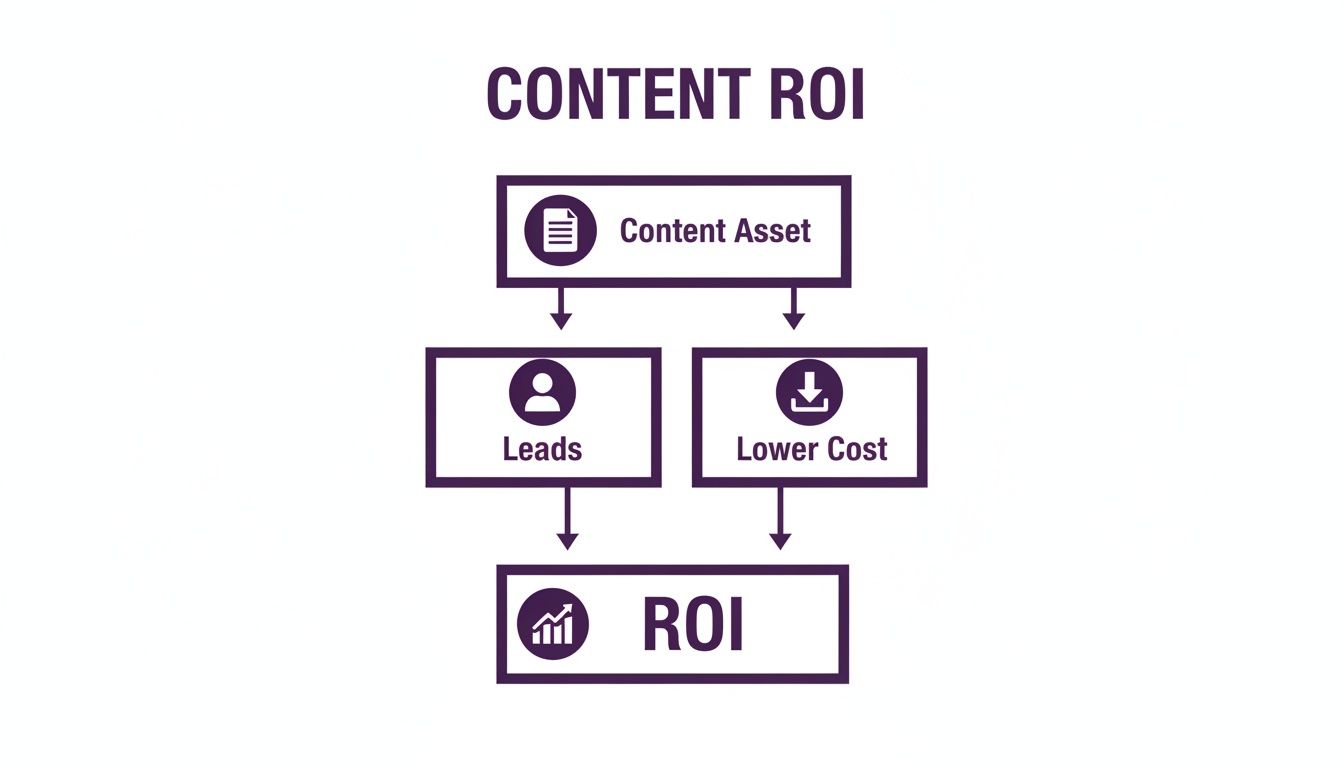
This diagram breaks down how a single piece of content can generate leads while lowering your acquisition costs, ultimately driving a real return on your investment.
As you can see, the initial effort to create a valuable content asset directly fuels both lead generation and cost efficiency—the two engines that drive positive ROI.
To make this even clearer, let's map out which formats work best for different marketing goals.
#### Choosing The Right Content Format For Your Goal
Selecting the right format isn't about chasing trends; it's about picking the right tool for the job. This table breaks down which formats are most effective for common marketing objectives, from simply getting your name out there to generating qualified leads.
| Marketing Goal | Primary Content Format | Secondary Content Format | Key Channel |
| :--- | :--- | :--- | :--- |
| Brand Awareness | Short-Form Video (Reels, TikToks) | Infographics, Social Media Posts | Social Media (Instagram, LinkedIn) |
| Thought Leadership | Long-Form Blog Posts, Whitepapers | Webinars, Podcast Interviews | Blog, LinkedIn, Email Newsletter |
| Lead Generation | Webinars, Ebooks, Gated Guides | Case Studies, Checklists | Landing Pages, Paid Ads, Email |
| Customer Nurturing | Email Newsletters, How-To Videos | Customer Stories, FAQ Content | Email, YouTube, Community Forums |
| Product Education | Demo Videos, In-Depth Tutorials | Blog Posts, Knowledge Base Articles | Website, YouTube, Email |
By aligning your content format with your specific goal, you ensure every piece you create is working as hard as possible to move your business forward.
Distributing Your Content Effectively
The final pillar is distribution. Honestly, even the most brilliant piece of content is completely useless if no one ever sees it. A smart distribution strategy is what makes sure your content actually reaches your audience across all the different places they hang out.
Free Strategy Insights
Get AI marketing strategies that work
Join founders and marketers getting weekly insights. No spam.
> "Content is king, but distribution is queen, and she wears the pants." – Jonathan Perelman
This old marketing quote is truer now than ever. Promotion is just as important as creation. A solid distribution plan usually blends a mix of different channels.
1. Owned Channels: These are the platforms you control, like your company blog, your email list, and your own social media pages. They’re perfect for nurturing the audience you already have.
2. Earned Channels: This is the organic buzz you get from other people, like mentions in the media, guest posts on other sites, and social shares from your community. This is where you build massive credibility and reach.
3. Paid Channels: This is where you put money behind your content through things like social media ads or sponsored articles. It's a powerful way to get in front of new, highly targeted audiences fast.
When you combine these three pillars—a deep understanding of your audience, the right format, and a multi-channel distribution plan—you create a cohesive strategy. This is what turns content from a simple marketing task into a predictable, reliable engine for growth. And if you're looking to put this on overdrive, you can explore our guide on automating your content strategy with AI agents to see how modern tools can streamline this entire process.
How To Create Your First Content Marketing Plan
Turning ideas into results requires a clear roadmap. Without a documented plan, content marketing feels like a series of random shots in the dark, producing unpredictable outcomes. A well-defined strategy, on the other hand, transforms your efforts from a guessing game into a predictable engine for business growth.
This isn't about creating some massive, complicated document that gathers dust. It's about building a practical, living framework that guides your decisions, keeps your team aligned, and makes sure every single piece of content you create serves a distinct business purpose. Let's walk through the essential steps to build your first one.
Step 1: Define Your SMART Goals
Every successful campaign starts with a clear destination. Before you even think about brainstorming a single topic, you have to define what success actually looks like for your business. The best way to do this is by setting SMART goals: Specific, Measurable, Achievable, Relevant, and Time-bound.
Vague goals like "get more traffic" are impossible to measure and lead nowhere. A real, actionable SMART goal sounds more like this: "Increase organic blog traffic by 20% in the next quarter."
Let's break that down:
* Specific: You know exactly what you’re trying to achieve (organic blog traffic).
* Measurable: You have a clear metric to track (20% growth).
* Achievable: The goal is realistic based on your resources and current performance.
* Relevant: It directly supports a bigger business objective, like generating more qualified leads.
* Time-bound: You have a firm deadline (the end of next quarter).
This level of clarity focuses your efforts and makes it painfully obvious whether your strategy is working or not. Aligning content with specific business outcomes is a core principle we explore deeper in our guide to building an AI marketing strategy.
Step 2: Conduct Audience and Competitor Research
Once your goals are locked in, you need to understand the playing field. This means looking outward at your competitors and inward at your ideal customer.
Start by analyzing what your competitors are doing right—and wrong. Use SEO tools to see which keywords they rank for and which topics are driving the most traffic to their sites. This isn't about copying them; it's about spotting content gaps and opportunities where you can provide a better, more thorough answer to a question your audience is already asking.
Next, get to know your audience on a deeper level by creating detailed buyer personas. Go beyond the basic demographics. Uncover their biggest pain points, their day-to-day challenges, and the exact questions they're typing into Google. This insight is the raw material for content that truly connects.
> A great content plan doesn’t just answer questions; it anticipates them. When you understand your audience's journey, you can create content that meets them exactly where they are with the information they desperately need.
Step 3: Brainstorm and Map Your Topics
With your research complete, it's time for the fun part: brainstorming content ideas. Gather your team (or just yourself) and generate a long list of potential topics based on your audience’s pain points and the keyword gaps you found.
But don't stop there. The next—and most crucial—step is to map each topic to a specific stage of the customer journey. This ensures you have a balanced mix of content that serves people at every step of their decision-making process, from casual browser to ready-to-buy.
1. Awareness Stage: The customer is just figuring out they have a problem. Content here should be educational and high-level (e.g., "What Is Content Marketing?").
2. Consideration Stage: The customer is now exploring different solutions. Your content should be more specific and helpful (e.g., "How to Choose the Right Content Marketing Tool").
3. Decision Stage: The customer is ready to pull the trigger. Content at this stage should build confidence and highlight why you're the best choice (e.g., "iSupplyAI vs. Competitor X: A Detailed Comparison").
This mapping process ensures you’re not just creating random articles, but actively guiding potential customers from their first flicker of interest to a final purchase.
Step 4: Develop a Content Calendar
An idea is just an idea until it's on a schedule. A content calendar is a simple but non-negotiable tool that turns your strategy into an actionable plan. It becomes the single source of truth for what’s being published, when it’s going live, and on which channel.
Your calendar doesn't need to be fancy; a shared spreadsheet often works perfectly. It just needs to include a few key details for each piece of content:
* Publish Date: The day the content will go live.
* Topic/Title: The working title of the piece.
* Content Format: Is it a blog post, a video, an infographic?
* Author/Creator: Who is responsible for getting it done?
* Status: In Progress, In Review, Scheduled, Published.
This simple tool eliminates chaos, ensures you're publishing consistently, and keeps your entire team on the same page. Consistency is one of the biggest drivers of content marketing success, and a calendar is your best friend in achieving it.
How To Measure Content Marketing Success
Creating great content is only half the battle. If you're not measuring your efforts, you’re just guessing. You can’t improve, you can’t double down on what works, and you certainly can’t prove the value of your work to your boss or investors.
This is where so many strategies fall apart. It's easy to get lost in surface-level "vanity metrics"—likes, shares, and retweets that feel good but don’t actually move the needle for the business.
To know if your content is truly working, you have to focus on key performance indicators (KPIs) that connect directly to business goals. This isn't about ignoring engagement; it's about looking deeper to see how that engagement drives meaningful action. Let's break down the metrics that actually matter.
Tracking Website Traffic And Sources
The most basic question is: are people actually finding your stuff? Traffic metrics tell you how many people you're attracting, where they’re coming from, and which pieces of content are your greatest hits.
You can find all of this in a free tool like Google Analytics. Start by tracking these core metrics:
* Unique Visitors: This shows the number of distinct individuals who visit your site. A steady increase means your reach is growing. Simple as that.
* Pageviews: This is the total number of pages viewed. If you see high pageviews on specific articles, that’s a huge signal that you’ve struck gold with that topic. Write more about it.
* Traffic Sources: This metric is crucial. It shows you whether visitors are finding you through organic search, social media, email, or direct visits. It’s your report card on how well your distribution channels are performing.
If you see that 80% of your traffic comes from organic search, you know your SEO efforts are paying off. On the flip side, if you're getting almost no traffic from social media, it might be time to rethink your promotion strategy on those platforms.
Measuring Audience Engagement
Once someone lands on your page, the next question is: do they care? Engagement metrics reveal how people interact with your content, giving you a powerful indicator of its quality and relevance. High engagement means you're not just attracting clicks; you're capturing attention.
> Measuring engagement is how you prove your content resonates. It's the difference between someone landing on your page by accident and someone staying because they found exactly what they needed.
Key engagement KPIs include:
* Time on Page: A longer average time on page suggests readers are genuinely reading your content, not just glancing and hitting the back button.
* Bounce Rate: This is the percentage of visitors who leave after viewing only one page. A high bounce rate can be a red flag, often indicating a mismatch between what the user expected and what your content delivered.
* New vs. Returning Visitors: A healthy balance here shows you're both attracting a new audience and building a loyal, returning one. You need both to grow.
Monitoring Conversion And Business Impact
This is where the rubber meets the road. Conversion metrics connect your content directly to business goals by tracking the specific actions you want users to take. These are the numbers that demonstrate tangible ROI.
A conversion isn't always a final sale. It can be any valuable action that moves a user further down the funnel.
1. Lead Generation: How many people filled out a contact form or downloaded an ebook after reading a blog post? This is a direct measure of your content's ability to generate new business opportunities.
2. Email Subscribers: Tracking how many readers sign up for your newsletter shows your content is valuable enough that they want to hear from you again. This is a huge win.
3. Sales and Revenue: With the right tracking in place, you can attribute actual sales to specific pieces of content. This is the ultimate proof that what you’re doing is working.
Evaluating SEO Performance
Finally, since content is a long-term asset, its impact on your search engine visibility is a critical measure of success. Strong SEO performance means your content is building a sustainable source of organic traffic that will pay dividends for years to come.
If you really want to get ahead, you can dive deeper into how to use AI tools for competitive analysis to spot valuable SEO opportunities your competitors have missed.
Key SEO metrics to watch are:
* Keyword Rankings: Are you climbing the search results for your target keywords?
* Organic Traffic Growth: Is the volume of visitors from search engines increasing over time?
* Backlinks: Are other reputable sites linking to your content? This is a powerful signal of authority to search engines and a massive validator of your content's quality.
Common Content Marketing Mistakes And How To Avoid Them
Even the best ideas can fizzle out with poor execution. I've seen countless promising content marketing efforts fail, not because of a lack of effort, but because of a few common, completely avoidable missteps.
Knowing these pitfalls is the fastest way to build a resilient and effective program from day one. By learning what not to do, you can sidestep the errors that cause so many businesses to give up way too early.
Creating Content Without A Strategy
The biggest mistake, hands down, is just diving in and creating content without a documented plan. This "publish and pray" approach gives you a random collection of articles and videos with no unified purpose. They don't target the right people and they certainly don't guide anyone toward a business goal. It's like building a house without a blueprint.
How to avoid it: Before you write a single word, define your goals. Pinpoint your audience. Research what your competitors are doing. Map out your topics. A clear strategy ensures every piece of content is a deliberate step toward a specific, measurable outcome.
Prioritizing Quantity Over Quality
The pressure to publish constantly can trick you into focusing on just churning out content. This almost always leads to shallow, rushed articles that don't rank, don't resonate, and don't help anyone. In the world of content, more isn't better. Better is better.
> One exceptional, in-depth article that solves a real customer problem is infinitely more valuable than ten mediocre blog posts that offer no new insights. Quality builds trust and authority; quantity just adds to the noise.
Think about it this way: your content is a direct reflection of your brand. If your content is subpar, your audience will assume your products or services are, too. For those trying to scale quality, understanding the difference between AI systems is key. You can discover more about how multi-agent AI compares to single AI in marketing to get a clearer picture.
Forgetting To Promote Your Content
Another critical error is hitting "publish" and thinking your job is done. The most brilliant piece of content on the planet is useless if no one ever sees it. Promotion isn't an afterthought; it has to be a core part of your workflow from the very beginning.
How to avoid it: You should spend at least as much time distributing your content as you did creating it. Build a multi-channel promotion plan that includes:
* Email Marketing: Share new content with your newsletter subscribers—they're your most engaged audience.
* Social Media: Post across all your relevant platforms, but tailor the message for each one. Don't just copy and paste.
* Community Engagement: Share your content in relevant online forums, Slack groups, and subreddits where your audience actually spends their time.
* Outreach: Connect with influencers or other publications that might find your content valuable enough to share with their own audience.
Got Questions About Content Marketing?
Even with a solid plan, a few questions always come up when teams first dip their toes into content marketing. Let's tackle the big ones so you can move forward with confidence.
How Much Does Content Marketing Cost?
This is a "how long is a piece of string?" question. The cost can swing from practically nothing to tens of thousands of dollars a month. You could start by writing blog posts yourself, or you could hire a full-blown video production crew.
The beauty of content is its scalability. A small business might start with a $500 to $2,000 per month budget to get a few high-quality blog posts from a freelance writer. A mid-sized company looking for a more aggressive approach—think video, social media management, and serious SEO work—might budget $5,000 to $15,000.
The key isn't to spend the most; it's to start with a budget you can sustain and focus on creating genuinely valuable assets.
How Long Does It Take to See Results?
Patience is a virtue here. Content marketing is a long game, not a quick hack. Unlike paid ads that give you an instant (but temporary) traffic boost, content builds momentum like a snowball rolling downhill.
You can generally expect to see meaningful results, like a real jump in organic traffic and leads, within six to nine months of consistent, quality work.
> Don't get discouraged if you don't see a huge traffic spike after a month. That first period is all about laying a foundation of quality content that search engines can start to trust and rank. Consistency is your best friend.
The first few months are for building your library. After about a year of steady output and promotion, you should have a reliable engine for organic growth that keeps paying dividends long after you hit publish.
What Is the Difference Between Content Marketing and SEO?
This one trips a lot of people up, but it's pretty simple: they're two sides of the same coin. They're different jobs, but they absolutely need each other to work.
* Content Marketing is the big-picture strategy. It’s about creating and sharing valuable stuff to attract the right audience. It's the "what" and the "why."
* SEO (Search Engine Optimization) is the technical side. It's the process of fine-tuning that content so Google can find, understand, and show it to people. It's the "how."
Think of it like this: Content marketing is writing the best book on a topic. SEO is making sure that book is on the right shelf in the library, with a clear title and a great cover so people actually find and pick it up. You need both. Amazing content with zero SEO is invisible, and perfect SEO with bad content won't convince anyone to stick around.
---
Ready to build a content engine that actually drives results? iSupplyAI gives you the tools to analyze your competition, generate high-performing content, and distribute it across all your channels with a single click. Stop guessing and start growing by visiting https://isupplyai.com to see how it works.
Free Strategy Insights
Get AI marketing strategies that work
Join founders and marketers getting weekly insights. No spam.
Share this article